
Steal Or Die Cases Guide: Skins at Random and the Shop Economy
Steal Or Die cases are the shop's random-skin boxes — 'skins at random', per the game's own menu. Where the shop is, what to buy first, and the loot-case mixup.
FAQ
What do cases contain in Steal Or Die?
How much do cases cost in Steal Or Die?
Where is the shop in Steal Or Die?
Should I buy cases or upgrades first?
Is the Lab Sample Case one of the cases?
Can you trade skins from cases?
Few words in Steal Or Die work as hard as “case”. The shop sells cases. The maps are full of cases you steal. One is a between-match cosmetic system, the other is the loot on the table in front of you, and search results happily mix them up. This page separates the two meanings, walks the shop to the Cases tab using what footage has actually captured, and marks the exact spot where the confirmed record runs out — because the honest answer about case contents and prices is “labeled, not yet filmed.”
What are cases in Steal Or Die?
The game answers this itself — you just have to catch the shop menu for a second. The shop’s left-hand navigation lists every purchase category with a two-to-four-word job description, and the Cases entry reads: “skins at random.” That is the whole confirmed definition. Cases are the mystery-box line of the shop: you pay banked cash, the game rolls you a skin.
The in-game tutorial mentions cases too, in the same breath as gadgets and energy drinks as things your run balance can buy. And the trade system completes the picture — its menu says skins are one of the three things players can swap with each other, so whatever a case rolls you, it is personal property you can pass on. The full swap rules live in the trading guide.
What the record does not have: the tab actually being opened. No available session clicks into Cases, so the skin catalog, the case lineup, and the pricing are all officially unconfirmed. This page keeps it that way rather than inventing a drop table.
Where is the shop in Steal Or Die?
The shop lives in the lobby’s left side menu, stacked under your balance and level: Shop on M, Locker on L, Trade on T, Rebirth on P. One creator’s session catches the full rail seconds after a completed run.
The shop itself is a dark storefront with seven tabs down the left edge, each with its own job description — and reading those descriptions is the fastest tutorial the game never gives you:
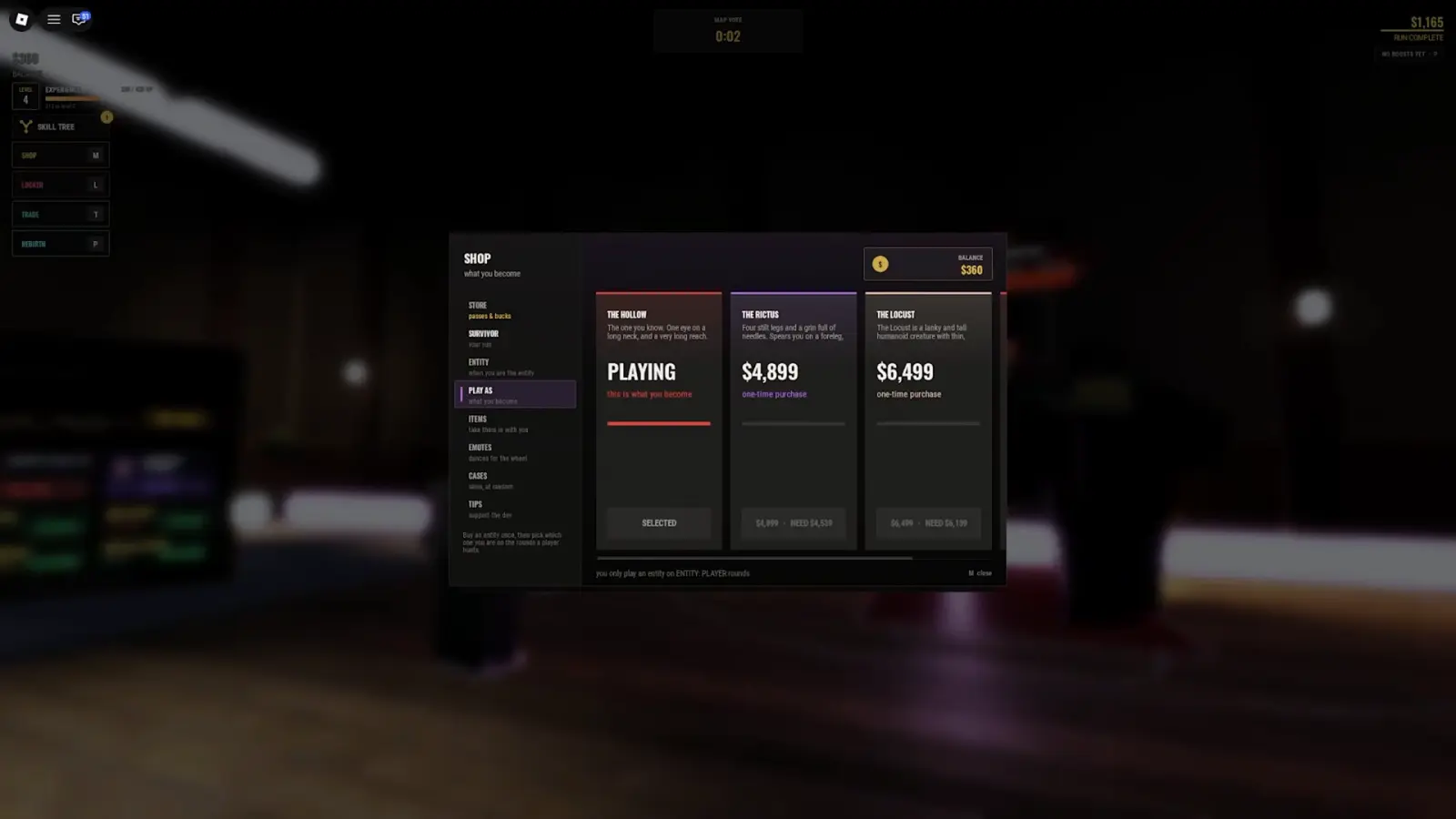 The shop’s Play As tab, with the whole navigation visible — including Cases, labeled “skins at random”, and Emotes, “dances for the wheel”. See 24:15 in the source video.
- Store — “passes & bucks”, the Robux side of the menu.
- Survivor — “your run”, the permanent stat upgrades.
- Entity — “when you are the entity”, hunter-side boosts.
- Play As — “what you become”, entity unlocks: The Rictus at $4,899 and The Locust at $6,499 as one-time purchases, with the menu noting you only play an entity on ENTITY: PLAYER rounds.
- Items — “take them in with you”, the gear you bring into a match.
- Emotes — “dances for the wheel.”
- Cases — “skins at random.”
- Tips — “support the dev.”
How much do cases cost?
Here the honest answer is a blank: no public footage opens the Cases tab, so the price of a case has never been on screen. The shop prices around it are documented, though, and they calibrate what “expensive” means in this economy — the same session that shows the shop also shows the Survivor tab:
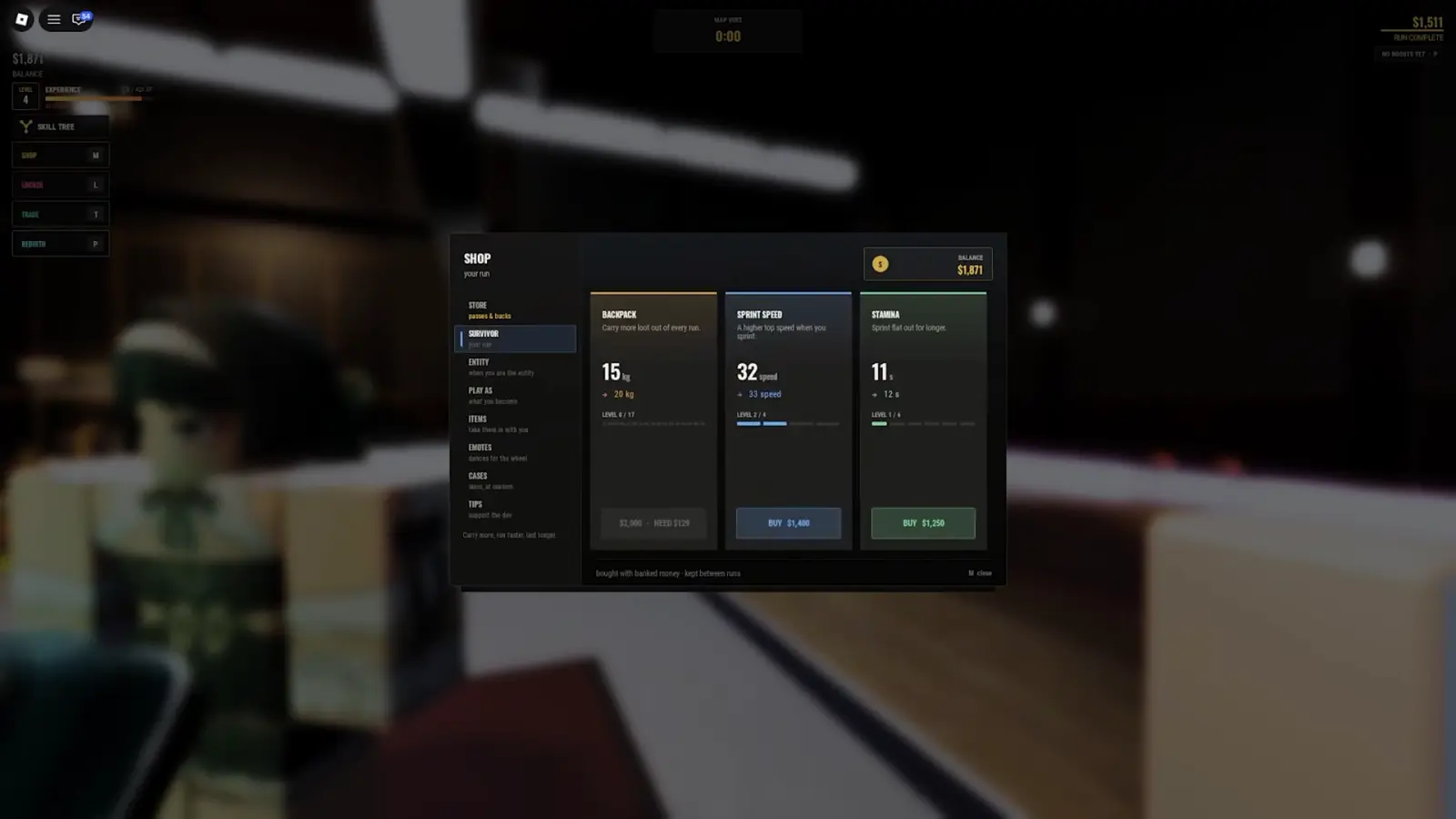 The Survivor tab: Backpack 15→20 kg ($2,000), Sprint Speed 32→33 ($1,400), Stamina 11→12 s ($1,250) — “bought with banked money · kept between runs”. See 29:54 in the source video.
So the verified price band runs from $1,250 (one stamina level) to $6,499 (The Locust), permanent purchases only. Against that scale, cases are almost certainly the cheap end — every cosmetic mystery box in this genre undercuts its own game’s functional upgrades — but “almost certainly” is not a price, and this page does not invent one. When a session films the tab, the value list is where the number gets logged alongside everything else with a confirmed price.
One more economy fact worth having: banked money persists. The same footage shows a run complete for $1,165 with the lobby balance already sitting at $2,960 — upgrades are bought with banked money and kept between runs, which is what makes them the safe first spend. Want faster income to feed the balance? That is the best loot guide’s routing problem, and the codes page is the honest answer to the free-money question.
Are “cases” loot? The Lab Sample Case mixup
Now the other meaning. Mid-match, “case” usually refers to loot boxes like the Lab Sample Case — a white biohazard container that spawns on tables and shelves, picks up a rarity roll, and pays out on extraction:
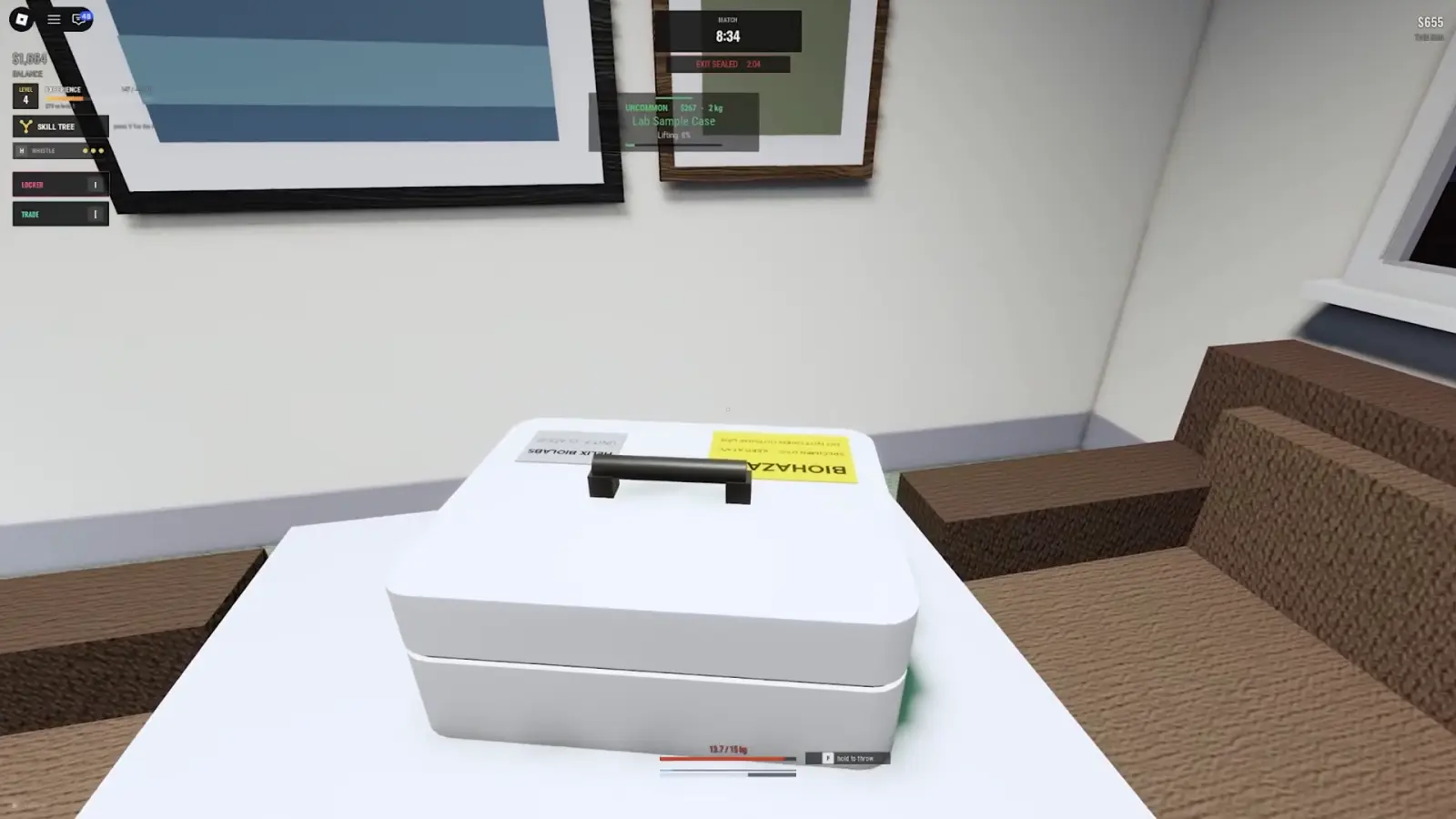 The loot meaning of “case”: an UNCOMMON Lab Sample Case roll at $267, 2 kg, lifting off a lounge table. See 15:01 in the source video.
The tooltip prints the roll — UNCOMMON, $267, 2 kg — and other runs have shown the same case at $32, so its payout floats like every item in the game. These map cases are income, not cosmetics: they weigh into your 15 kg limit, they die with your run if the entity catches you, and the value-per-kilogram argument for which loot deserves the bag space lives in the value list.
The two systems never touch. You cannot trade a Lab Sample Case through the trade menu, and you cannot wear a shop case into a match. If a search result merges them, that is how you know it was written about a different game — or by a script.
So, are cases worth buying?
Treat them as the last line of the shop, not the first. The confirmed purchases that change outcomes are the Survivor upgrades — more backpack, more speed, more stamina, kept between runs — and they cost four figures each. Entity unlocks change your hunter side for five figures of grinding. Cases make you look different, and until the tab is filmed, exactly how different and for exactly how much are open questions. Buy your fun-money case after the upgrades, not instead of them — and if a skin rolls that you do not want, the trade menu is the exit the game built for it.
Sources and footage credit
Every screenshot and price on this page comes from FusionZGamer’s long Steal Or Die session (watch the source video on YouTube), cross-checked against the in-game tutorial text quoted across this wiki. Menu strings — including “skins at random” — are quoted exactly as rendered on screen. Case contents, drop odds and case prices remain unconfirmed; this page will say so until footage exists.

STEAL OR DIE.. (FusionZGamer full session with the shop walkthrough)
Related Articles
bosses
The Rictus in Steal Or Die: Unlock Cost & Hunt Guide
The Rictus costs $4,899 in Steal Or Die's shop. See its exact card, selection rules, attack prompt, and a full player hunt before spending your cash.
guides
Steal Or Die: How to Play as an Entity and Pick a Monster
Learn how to play as an entity in Steal Or Die: choose a monster, vote ENTITY: PLAYER, and understand why buying 2x chance never guarantees the role.
guides
Steal Or Die Survivor Upgrades: Backpack, Speed & Stamina
Spend banked cash on Steal Or Die survivor upgrades. Compare Backpack, Sprint Speed and Stamina, check filmed prices, and separate them from skill points.
Was this helpful?
Thanks for the feedback!